
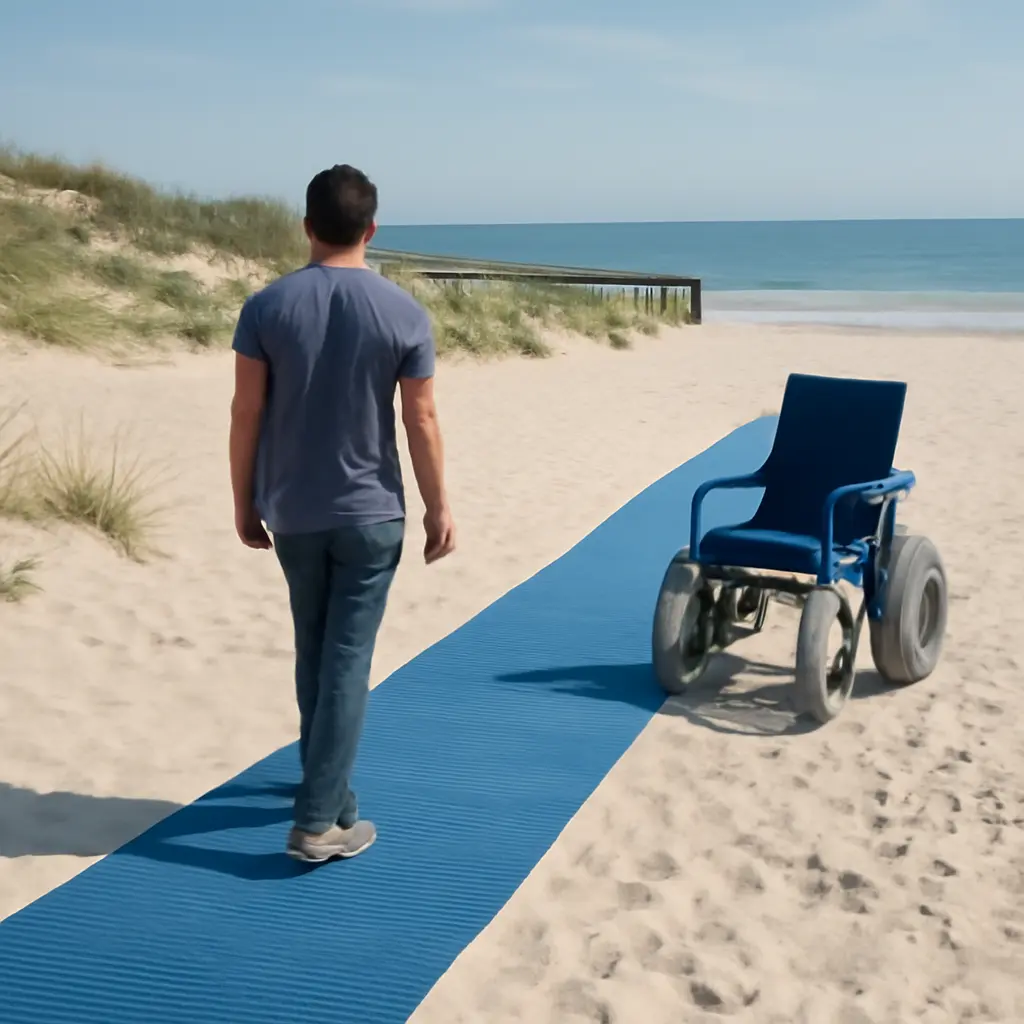
Accessible beach design is reshaping coastal towns by making shorelines easier to reach and use for people with disabilities, older adults, families with small children, and others who face barriers in sand and surf. The shift goes beyond adding a ramp: it can include firm-surface routes, beach wheelchairs, accessible restrooms and parking, clear wayfinding, and water-access features. The need is substantial: the U.S. Centers for Disease Control and Prevention estimates that 28.7% of U.S. adults—about 1 in 4—have a disability. Federal accessibility standards set important requirements for many built features, while local projects show how thoughtful design can connect those standards to the lived experience of a beach visit.
Accessible beach design expands coastal access
Accessible beach design is the planning and provision of routes, facilities, equipment, and information that enable people with different abilities to approach, enter, and enjoy a beach. The U.S. Access Board’s guide to the Americans with Disabilities Act (ADA) standards explains technical requirements for accessible routes and other facilities; beach accessibility also involves practical choices such as whether a route reaches the water and whether visitors can obtain a suitable beach wheelchair.
The idea matters because shore access is not a single doorway or path. A visitor may be able to park but not reach the sand, or reach the sand but lack an accessible restroom. In its 2024 report, the CDC estimated that 28.7% of U.S. adults had a disability, including mobility, cognition, hearing, vision, and independent-living disabilities. That figure is a national measure, not a count of people who visit beaches, but it underscores why inclusive design affects a large share of the public.
Accessible routes connect the whole visit
An accessible beach route is a firm, stable path that links relevant facilities—such as accessible parking, restrooms, and a beach entrance—and continues toward the beach where required and feasible. Under the U.S. Access Board’s ADA standards, routes generally must meet specified requirements for width, slope, cross slope, and surface. Outdoor conditions complicate the task: loose sand can make a path impassable for wheelchair users, while tides, storms, and shifting dunes can change the shoreline from season to season.
A route therefore works best as part of a continuous chain of access rather than as an isolated ramp. Towns can assess where the route begins and ends, how it is maintained, and whether it connects visitors to the facilities they need. The Access Board’s technical guidance helps distinguish regulatory specifications from design decisions that depend on site conditions.
Beach wheelchairs and mobility equipment extend access
Beach wheelchairs are mobility devices designed to travel over sand, often using wide wheels that distribute weight more effectively than standard wheelchair tires. Some communities lend them at no cost or by reservation; others provide them through lifeguard stations or recreation departments. Availability, booking rules, transfer assistance, and storage can determine whether the equipment is genuinely usable for a visitor.
These chairs complement, rather than replace, an accessible route. A visitor may need a route to reach the equipment, a staff member to explain its operation, and a companion or personal assistance to use it safely. Because beach-wheelchair programs differ by location, towns should publish current details and invite feedback from disabled residents and visitors.
Inclusive beach features serve different access needs
Inclusive beach design includes more than mobility access. It considers how people with sensory, communication, cognitive, and health-related needs experience the coast. Universal design—a planning approach that aims to make environments usable by as many people as possible—offers a useful framework, but it does not eliminate the need for specific accessibility features or individualized accommodations.
Facilities and services support independent visits
Accessible parking, restrooms, changing areas, showers, seating, and shaded rest points can make a beach visit possible for people who otherwise face barriers. The U.S. Access Board’s standards address technical requirements for many elements of the built environment, including accessible parking and toilet facilities. Local planners should also consider whether facilities are open during beach operating hours and whether signs make them easy to locate.
Access to the water is a distinct challenge. Some beaches install beach access mats or boardwalks toward the shoreline; others provide transfer platforms or floating beach wheelchairs. These options have different limitations, including changing tides, wave conditions, maintenance needs, and effects on dunes or habitat. Site-specific assessment is essential, and a feature should not be described as universally accessible if visitors cannot reliably use it.
Information and wayfinding reduce uncertainty
Accessible information tells visitors what to expect before they arrive and helps them navigate once they are there. Useful details include route surfaces and slopes, parking locations, restroom access, beach-chair availability, reservation procedures, water conditions, and contact information. Clear signs, readable maps, and information offered in more than one format can support visitors with different communication and sensory needs.
This information is especially important because beach conditions change. A route may be temporarily closed after a storm, equipment may be out for repair, or surf conditions may restrict water access. Municipal websites and on-site signs should be kept current, and staff should know how to answer questions without making assumptions about a visitor’s abilities.
Coastal towns are turning access principles into local projects
The design challenge is to combine public access, safety, environmental stewardship, and long-term maintenance. Beaches are dynamic landscapes: storms and erosion can damage infrastructure, while dunes and coastal habitats may be protected. A successful project therefore begins with local conditions and meaningful participation, rather than assuming that one design suits every shoreline.
Community-led planning identifies barriers early
Community-led planning involves disabled residents, accessibility organizations, beach operators, emergency services, and coastal-resource specialists in decisions about routes and facilities. These participants can identify practical barriers that a plan review may miss, such as a steep approach, an inconvenient equipment checkout process, or a route that ends far from the water.
The National Park Service’s accessibility guidance emphasizes that access improvements must be considered alongside the characteristics of parks and outdoor environments. For coastal towns, that means evaluating alternatives that preserve sensitive resources while improving the visitor experience. Consultation should happen early enough to influence design, and continue after opening so that maintenance and operating practices can be corrected when problems emerge.
Maintenance makes accessibility dependable
Accessible design is an ongoing service, not a one-time construction project. Sand accumulation, corrosion, storm damage, loose boards, broken mats, and unavailable equipment can undermine access even when a facility initially meets its design goals. Towns can assign inspection responsibilities, set repair timelines, and provide a way for visitors to report barriers.
A practical access audit can track whether routes are open and stable, whether signs remain legible, and whether beach wheelchairs are in working order. Seasonal reviews are especially useful because beach conditions and visitor demand vary throughout the year. Tracking complaints and repair times can help towns decide where limited funds will have the greatest effect.
Inclusive beaches strengthen public life and coastal resilience
Accessible shorelines can broaden participation in recreation and public life, while improving convenience for many visitors—including older people, caregivers with strollers, and anyone who benefits from a stable path. These shared benefits are often called the “curb-cut effect”: features designed to remove barriers for one group can help others as well. The precise benefits vary by project, so towns should measure local use and listen to visitors rather than assume every feature works equally well for everyone.
The broader lesson is that access and coastal stewardship need not be treated as competing goals. Careful siting, durable materials, seasonal maintenance, and engagement with both disabled people and environmental experts can help communities improve access while respecting sensitive shorelines. An illustrative project dashboard could chart route availability, wheelchair-loan use, facility outages, and visitor feedback across the season; such a chart would show whether access is dependable, not merely whether infrastructure was installed.
Conclusion
Accessible beach design connects routes, mobility equipment, facilities, clear information, community participation, and maintenance into a more complete coastal experience. The CDC’s estimate that 28.7% of U.S. adults have a disability makes the stakes clear, while the U.S. Access Board’s standards provide a foundation for accessible built features. Coastal towns can move from minimum compliance toward dependable inclusion by auditing the entire visitor journey, consulting disabled people early, and keeping improvements usable after storms and seasonal change. Residents and visitors can help by reporting barriers and asking local governments to publish access information and maintenance plans.
Sources: Centers for Disease Control and Prevention, Disability Impacts All of Us, 2024, https://www.cdc.gov/disability-and-health/about/; U.S. Access Board, Guide to the ADA Accessibility Standards, https://www.access-board.gov/ada/guides/; U.S. Access Board, Outdoor Developed Areas: A Summary of Accessibility Standards for Federal Outdoor Developed Areas, https://www.access-board.gov/aba/guides/chapter-10-outdoor/; National Park Service, Accessibility, https://www.nps.gov/subjects/accessibility/index.htm.